A good nail strengthener protects and hydrates nails but can't rebuild them. Look for keratin, biotin, or calcium, and avoid formaldehyde.
Gel manicures and a few too many acrylic sets can leave nails thin, bendy, and prone to splitting. The reflex fix is another coat of polish, but that may be the wrong move. A good nail strengthener addresses the nail itself, and it's worth knowing what a product can and can't do before you buy one.
What a strengthener can and can't do
Nails are made of dead keratin. Once a nail has grown out, you can't rebuild its structure from the inside. What you can do is protect the surface and improve the conditions it grows in. A strengthener shields nails from the environment, adds moisture, and forms a thin scaffold across the surface that helps reduce breakage. That's a real benefit, though it's a more modest claim than the packaging often implies.
Used consistently, a strengthener can help strengthen brittle nails and may support faster growth. The payoff is length you keep, because nails that don't snap at the edges can actually get longer. That's the practical argument, and it's a better one than "instant repair."
Dermatologist Joshua Zeichner, M.D., director of cosmetic and clinical research in dermatology at Mount Sinai Hospital in New York City, puts it simply: you can't change a nail's structure after it forms, but you can improve what's already there.
How we tested them
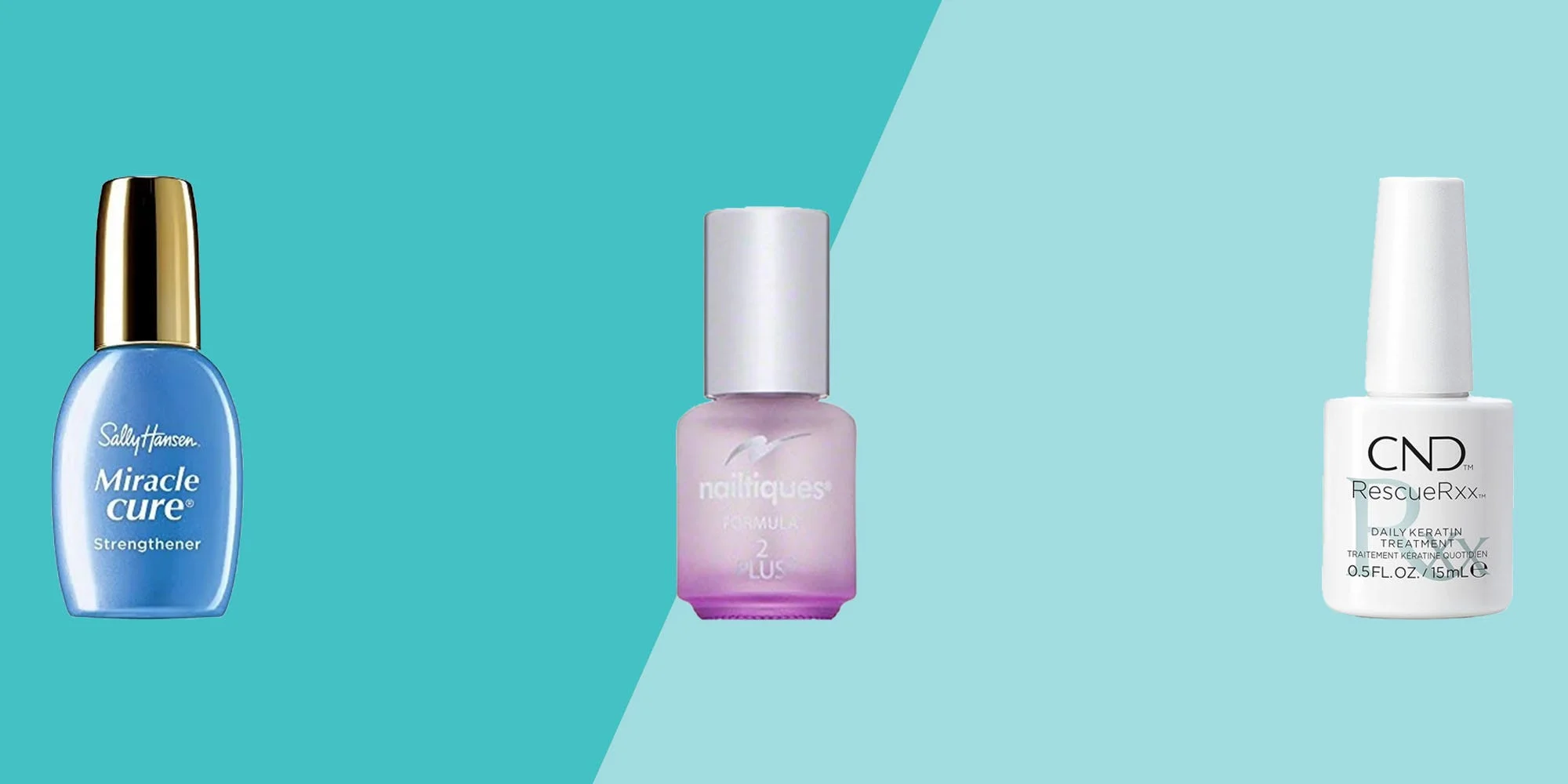
We tested the strengtheners below over several months, scoring each on how well it reduced breakage, how it changed the look and feel of brittle nails, and whether it helped with flexibility and hydration. The lineup includes CND RescueRxx, OPI Nail Envy, OPI Repair Mode Bond Building Nail Serum, the Dr. Dana Nail Renewal System, and Manucurist Active Glow Blueberry.
We also included recommendations we didn't test ourselves. Those come from three board-certified dermatologists in New York City and Philadelphia: Dr. Zeichner, Pooja Rambhia, M.D., and Michele Farber, M.D., F.A.A.D. Treat that section as expert opinion, not hands-on results.
Ingredients to look for and avoid
Start with the label. The strongest formulas combine fortifiers such as keratin, biotin, or calcium with moisturizers that counter the dryness that makes nails brittle. Dr. Farber also points to collagen and protein as useful for growth.
Then check for what shouldn't be there. Formaldehyde and formalin can make nails feel harder almost immediately, but with repeated use they tend to cause more brittleness and damage. That trade-off is the real problem: the product feels like it's working while it's making the nail worse.
Products worth a closer look
Dr. Rambhia's pick is the Nailtiques Formula 2 Treatment, and it covers most of the checklist. It's enriched with protein and calcium, dries fast, and works under polish for added protection. At roughly $8, it's also one of the cheapest options here. Dr. Farber says it works alone or as a base coat, and it fills in the cracks and ridges that lead to peeling and snapping. It's not a miracle product, but it's a sensible starting point.
The OPI serum is the one I keep coming back to. I wear gel polish constantly, and my nails get bendy and weak between appointments. After a few applications, the difference was obvious: stronger nails and less breakage as they grew out. It absorbs into the nail more like a moisturizer than a coating, so it dries quickly. You can wear it under regular polish, but not under gel, which is a real limitation if gel is your default.
CND's RescueRxx is the product I've used for four years. It works as a strengthener and a cuticle oil at once, with keratin and jojoba oil that hydrate the whole nail and help with peeling skin, hangnails, and brittleness. I use it between manicures and see a difference within days. It also doubles as a cuticle oil on freshly done nails. The caveat is fragrance. If you're sensitive to scents, skip it.
Dr. Rambhia likes OPI's sensitive-nail formula for peeling nails. She says it's free from formaldehyde, formalin, and toluene, and it includes aloe vera and vitamins meant to nourish fragile nails gently. Assistant Editor Jenn Gonick has used it as her base coat for years. She points to its biotin, calcium, and vitamins, and says it dries fast enough that it's easy to fit into a quick manicure. Two coats on bare nails, she says, make them look neat in minutes.
For severely dry, brittle nails, the Kur recovery treatment is a bigger commitment. It combines AHAs, vitamins B5 and C, and a proprietary botanical blend called Florium Complex. Nail techs and estheticians recommended it to the writer, and the routine is demanding: daily application for a week, every other day in week two, then once a week from week three on. The payoff, in one tester's experience, was a shift from cracked, flaking nails to smooth, glossy ones. The effort is real, but so is the result.
If you want something that acts more like skincare, look at the hyaluronic acid serum. It's fast-absorbing and leaves no residue, lacquer, or texture. Third-party testing reportedly found clinically significant improvements in the appearance, roughness, and thickness of nails within 28 days of daily use. Treat that as a manufacturer-funded result until you see the study details, but the claim is specific enough to be checkable.
Prefer a cream? Onyx Professional's formula combines calcium with vitamin E, glycerin, urea, coconut oil, and jojoba oil. It targets brittleness and moisturizes cuticles, which Dr. Farber values in a product that does two jobs. Sally Hansen's Good. Kind. Pure. hardener is the plant-based option Dr. Rambhia recommends. She notes that it's free from formaldehyde, formalin, toluene, and other harsh chemicals. It works alone or as a base coat with the rest of the line, which includes color polishes, a top coat, and an oil.
Buying tips from the dermatologists
Choose effective ingredients. Look for collagen, protein, keratin, biotin, and calcium. Dr. Rambhia says these help "reinforce nail structure and promote thickness."
Focus on hydration. Dry nails are brittle nails. Dr. Farber recommends pairing a strengthener with a cuticle oil, and suggests checking labels for glycerin, jojoba oil, and vitamin E to keep nails hydrated.
Avoid harsh formulas. Formaldehyde and formalin top the list. Dr. Rambhia also flags toluene sulfonamide, which helps polish stick but can trigger allergic reactions and irritation in sensitive people. Repeated use of drying products can also make nails more brittle over time.
Be consistent. Dr. Farber suggests applying a strengthener once a week, either alone or as a base coat that shields the nail from polish and remover. When in doubt, follow the product's directions. A strengthener only works if you keep using it.
Nails grow slower than you'd think
Fingernails average about 3.0 mm of growth a month. Toenails manage roughly 1.0 mm. That gap matters when you're waiting out a break or a repair, because a nail that splits at the tip can take months to grow out. Dermatologist Pooja Rambhia, M.D., points to research suggesting nail growth slows by about 0.5% per year starting around age 25. The change is small year to year, but it adds up. She also notes that weak nails or nails that refuse to grow can have many possible causes, so the fix depends on which one applies to you.
What strengtheners can and can't do
Over-the-counter nail strengtheners are the first thing most people reach for, and Rambhia considers them useful for protecting nails that break easily. Many are built around keratin, the protein that makes up the nail, and biotin, and they're designed to thicken the nail and reinforce its structure. The mechanism is specific: the keratin in these formulas is crosslinked, which makes the nail more durable. Many also include moisturizers aimed at the dryness and brittleness that tend to cause breakage in the first place.
Here's the thing, though: none of these products speed up growth. Dr. Zeichner is blunt about it. Topical products don't change how fast the nail grows. What they do is protect the nail, which lets it reach a longer length than it would otherwise manage before snapping. Dr. Farber describes the same benefit from a different angle, saying strengtheners lock in moisture against dry, brittle nails and that some formulas add protein and collagen to make conditions better for growth. If you're expecting a product to double your nail length in a month, you'll be disappointed.
And if a strengthener doesn't seem to do anything after consistent use, Rambhia recommends seeing a dermatologist. Persistent problems can point to an underlying health issue, and no bottle can diagnose that.
The habits that do the damage
Most nail problems trace back to routine, which is good news because routine is easier to change than biology. Rambhia's first recommendation is to keep nails short and tidy. If you're seeing splits or chips, trim regularly and keep them on the shorter side, since longer nails are more prone to breaking.
Your manicure is the second suspect. Some nail polishes and polish removers contain drying ingredients, and Dr. Farber suggests giving nails a regular break from color. Rambhia goes further with gel and acrylic manicures, which she says can weaken the nail plate with repeated exposure and leave it more fragile. A practical middle ground is a few days to a week off between manicures, with only a strengthener applied during that window.
Water is the third. Prolonged wet exposure softens nails, making them easier to damage. People who spend a lot of time with their hands in water, whether dishwashing or cleaning, can wear gloves to limit contact. It's a dull fix, and it works.
Hydration and protein do the quiet work
The internal side matters too. Rambhia advises moisturizing the nails and the skin around them regularly, and pairing that with enough water to prevent brittleness. In practice, that means keeping a water bottle nearby, a hand cream at the sink, and a cuticle oil for the skin that borders the nail.
Diet is the other lever. Since nails are made of keratin, a protein, Rambhia says adequate protein intake is essential to nail health. Lean meats, tofu, and legumes all fit the bill. None of this is glamorous, but if your nails are weak, your protein intake is the first thing worth checking.
The realistic takeaway
Strong nails come from a boring stack of habits: protect them, keep them short, take polish breaks, stay hydrated, eat enough protein, and wait. Strengtheners help with the protecting part, and they're worth using. But they're a support system, not a growth treatment. If you're working against a slow-growing nail and a stubborn habit at the same time, change the habit first. The product won't fix what the routine keeps breaking.


Discussion
Sign in to join the discussion.