A life-long hair loss diagnosis, years of steroid shots, and a late-arriving JAK inhibitor: one patient's account of alopecia areata and the treatment that finally worked.

The first sign was a bald spot that a stylist noticed during a blowout. I was in eighth grade, and I wore my hair in braids most of the time, so nobody had a clear view of my scalp. She had been doing my hair every other month for years, and she knew it well enough to spot the change. She told me it was probably nothing and that I should keep an eye on it. I did, for a while, and then the patch grew back on its own and I stopped thinking about it.
It came back in high school, and it was worse. Puberty brought a new level of self-consciousness, and I spent more time in the mirror than I'd like to admit. Running my hands through my hair became a habit, and one day I noticed the bald spots were bigger and a thinning patch had appeared at my hairline. I was 16. My parents took me to the family doctor, who sent us to a dermatologist. She examined my scalp and gave me a diagnosis: alopecia areata, an autoimmune skin condition that causes hair loss in patches.
Shots, Wigs, and No Clean Answers
I expected a diagnosis to come with a plan that would fix things. What I got was a list of unknowns. I kept asking the same questions: what does this mean, and what can we actually do? The dermatologist explained that nobody knows exactly what triggers alopecia areata. Stress and anything that affects the immune system are thought to play a role. She offered topical treatments, and they didn't work for me. I covered the patches with powder from a beauty-supply store and hoped nobody would look too closely.
That was hard to accept. In the Black community, hair length is something you work for. You try products, you learn what your hair tolerates, and you spend years getting to a length you're proud of. I had just reached that point when the patches took it away. I had never worn a wig or a weave, and I wasn't ready to start. By my junior year, though, my mom had seen enough. "I just want my baby girl to feel good," she said, and she took me to buy one.
I went back to the dermatologist and asked for something stronger. For about a year and a half before college, I received corticosteroid injections directly into my scalp. They hurt badly. My mom had to come to school to drop off numbing cream, then return two hours later to drive me to the appointment. I would have done nearly anything to hold on to my hair, and that's what I was doing.
College, Grief, and a Relapse
The shots worked well enough by senior year that I could cut my hair short and wear it that way. I was thrilled to start college with my own hair. I was homesick at first, but I found a group of friends, and things were going well.
Then, at the end of my first year, my grandfather died. The grief was heavy, and I believe it pushed my immune system back into overdrive. Between adjusting to campus life and mourning him, my condition came back hard. I stayed bald from sophomore through senior year. My eyebrows eventually fell out completely, and I had to get microblading to fill them in.
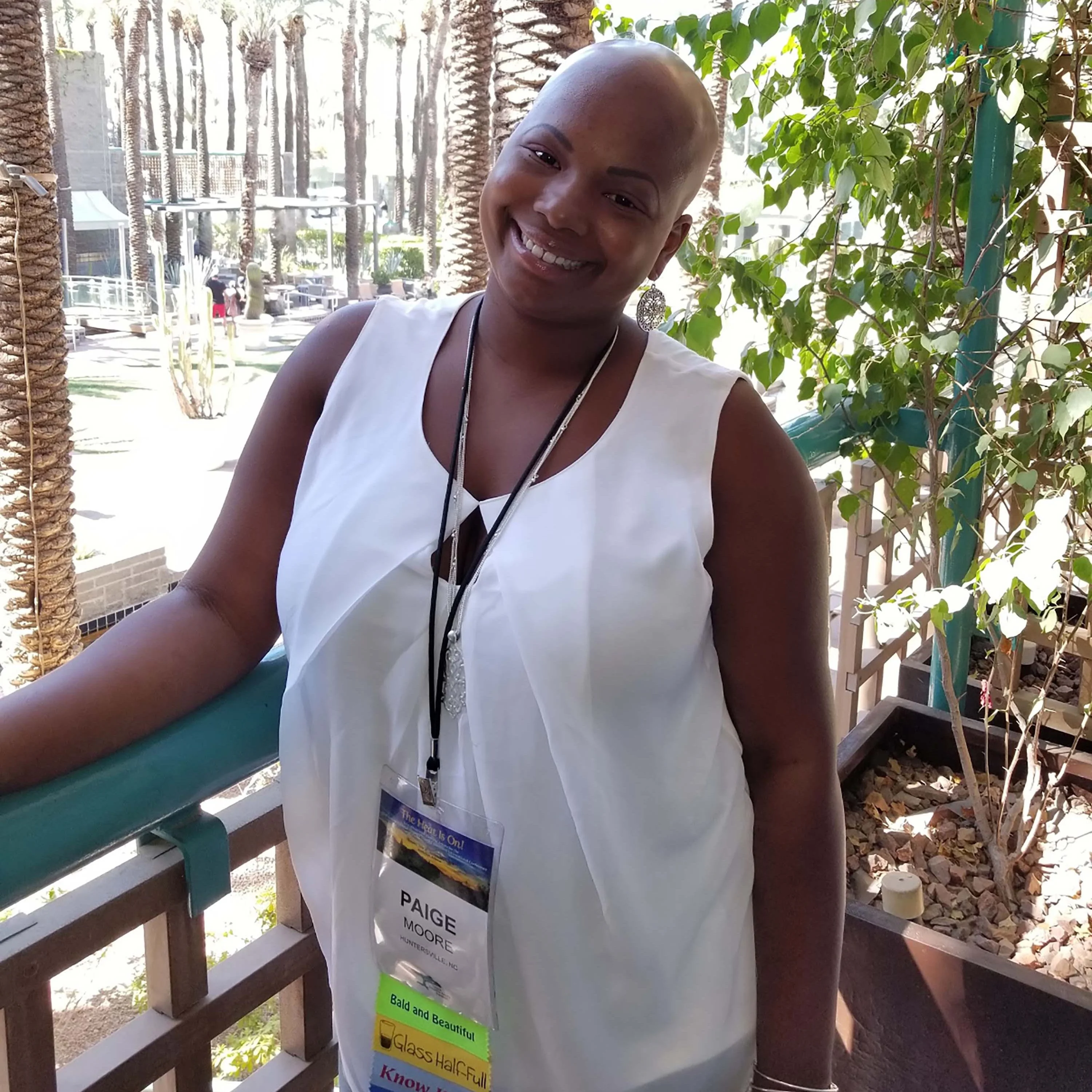
I was lucky in one way. I attended an HBCU, a historically Black college, where wigs were a familiar and accepted way to change your look. Nobody treated my hair as a crisis. I didn't feel like I was standing out in a crowd. Still, I felt isolated, because I didn't know anyone else living with what I had. That changed when I connected with the National Alopecia Areata Foundation (NAAF). It gave me support, real information, and regular updates on clinical trials and new treatments. For the first time, I understood I wasn't the only one dealing with this.
A Treatment That Worked, Until It Didn't
By senior year, I had started a JAK inhibitor, a class of drugs that targets the overactive immune pathways driving the hair loss. It worked. My hair grew back. Then, after a while, it stopped responding.
In 2025, I attended a NAAF conference where I heard about a newer JAK inhibitor, Leqselvi, that had just been FDA-approved specifically for alopecia areata. It felt like a last chance. If it failed, I was looking at wearing wigs for good.
I started taking it twice a day, and within two months I saw new growth. Now I can style my hair in finger waves, and I'm still getting used to having hair again. That's a strange feeling after so many years of planning my life around a wig. I still wear wigs sometimes, and I like having a choice. Some mornings I just wake up and don't have to think about it at all.
I'm 27 now. I work full time, I have a boyfriend who has been incredibly supportive, and I feel beautiful in more ways than I used to. Looking back, the hardest part wasn't the hair loss itself. It was the sense that every appointment was a gamble and that the people treating me couldn't promise me an outcome.
Not everyone with alopecia areata wants treatment. That's a personal decision, and I know women who look stunning without any hair. My point is that options exist, and resources exist too. If you're going through this, look into them so you can choose what's right for you.
What Alopecia Areata Actually Is
"Alopecia areata [AA] is an autoimmune disease in which the immune system mistakenly attacks the hair follicle, disrupting the normal hair growth cycle and resulting in hair loss," says Joseph W. Fakhoury, M.D., assistant professor of dermatology and director of the Alopecia Clinic at the University of Maryland. He estimates that seven million Americans will experience AA at some point in their lives, and about 700,000 are living with it now. The good news is that the follicle isn't permanently destroyed by the immune attack, which is why regrowth is possible. "Fortunately, the hair follicle is not permanently destroyed by this immune attack, which is why hair regrowth remains possible," Dr. Fakhoury says.
AA typically shows up as circular, coin-sized patches. It can affect the scalp, eyelashes, and eyebrows, and sometimes hair on the arms and legs. Research suggests it affects more women than men, and it is more common in the Asian, Black, and Hispanic communities than among white Americans. No one knows the exact cause. Dr. Fakhoury explains that it's thought to result from a mix of genetic susceptibility and outside triggers, such as a virus or environmental factors, that set off an abnormal immune response. For many people, it begins in childhood.
AA causes no physical pain, but it can take a real toll on mental health as people adjust to hair loss. Some people live with it or cover up with scarves, hats, or wigs. Others pursue treatment, which can include topical steroid creams, corticosteroid injections, oral steroids, topical immunotherapy, and oral JAK inhibitors.
"For patients with severe alopecia, [oral JAK inhibitors] are the preferred first-line systemic treatment option," Dr. Fakhoury says. "They target the inflammatory signaling pathways responsible for the autoimmune attack on hair follicles." He also points out that more options exist now than ever, with more in development. His advice to patients is direct: "Find a dermatologist who specializes in hair loss, advocate for yourself, and remember that your hair loss does not define you."
For more information, visit the National Alopecia Areata Foundation.



Discussion
Sign in to join the discussion.