In 2023, a third of inpatient admissions for mental health and substance use challenges highlight disparities in treatment access and escalating costs for insured individuals.
**Understanding Inpatient Mental Health and Substance Use Treatment in 2023**
The mental health crisis in the United States has reached a pivotal point, particularly in how treatment is accessed and covered by insurance. Recent data reveals that about **20% of individuals with private health coverage experience some form of mental illness**, with a further **5% grappling with serious mental health issues**. This raises alarms about the adequacy of support systems in place for a significant portion of the population.
Research focused on those aged 18 to 64 covered by large employer-sponsored plans indicates that individuals enrolled in private insurance account for roughly **26% of all inpatient admissions** for mental health and substance use disorders. In comparison, **Medicaid** covers **41%** of these admissions, while **Medicare** accounts for **22%**. This disparity highlights the critical role public programs play in mental health treatment, and it sparks questions about how private insurance aligns with the actual needs of patients.
Utilizing claims data from the **2023 Merative MarketScan Commercial Claims Database**, this report not only identifies the most prevalent diagnoses for inpatient treatment but also delves into the associated financial burdens. The analysis defines inpatient treatment as hospital stays requiring overnight accommodation, whether for psychiatric care, substance use hospitalization, residential rehabilitation, or detoxification services. It's worth clarifying that this analysis excludes emergency department visits unless they resulted in a formal admission.
### Key Insights on Treatment Costs and Diagnoses
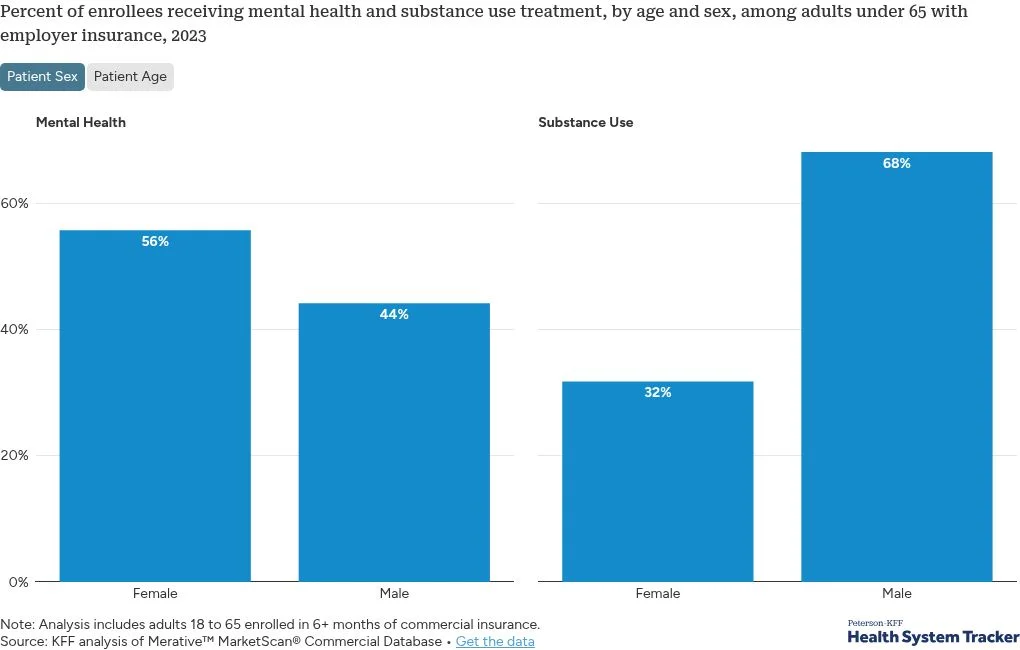
In 2023, **10% of all commercial inpatient stays** were attributed to mental health and substance use, equating to about **32 admissions per 10,000 enrollees**. Among these, the predominant diagnosis for 54% of admissions was mental health issues, notably depression, while 46% were related to substance use disorders.
Digging deeper, **the average total cost for a mental health inpatient stay stood at $15,900**, while those for substance use averaged slightly lower at **$15,500**. The bulk of these individuals—**82% for mental health and 65% for substance use**—only required a single inpatient treatment during the year. These costs reflect a broader financial strain, especially seeing that patients covered by private insurance are responsible for about **9% of the overall costs** associated with their admissions, which is markedly higher than the usual out-of-pocket responsibility for hospitalizations.
### Broader Context of Accessibility and Quality
This escalating cost for treatment, paired with the **unmet care needs**—as evidenced by about **40% of insured adults** in poor mental health reporting not receiving necessary care—emphasizes that financial investments in mental health services do not necessarily equate to effective accessibility. **Policy changes** are also evolving, yet enforcement of the **Mental Health Parity and Addiction Equity Act (MHPAE)** remains a significant hurdle.
Furthermore, while quality measures were not the focal point of this analysis, tools like the **Inpatient Psychiatric Facility Quality Reporting** can provide insights into treatment effectiveness and patient outcomes. The narrative emerging from this data is complex, conveying a system where the rising costs of care collide with challenges in accessibility and quality—suggesting that while spending may be ramping up, many system-level issues remain persistently unresolved.
What does this mean for anyone involved in the mental health sector? The current trends are concerning. For treatment providers, understanding these dynamics can help advocate for better systems and practices. For insurers and policymakers, there’s an urgent need to ensure that increasing expenditures translate into accessible and quality care for all those in need.The recent analysis sheds light on the evolving landscape of inpatient mental health and substance use treatment, revealing some critical insights into not just the lengths of stay but also the mounting costs to patients. For many seeking rehabilitation or detoxification, the average stay clocks in at just six days for rehab and four days for detox. These averages raise an important question: Are such brief treatments enough for the complexities of substance use disorders?
Diagnosis and comorbidities play significant roles in determining the required length of stay, with more complicated cases often necessitating extended care. However, the current treatment duration may not align with what many patients genuinely need for recovery. This disconnect is concerning, especially given the statistics showing that one in four inpatient mental health admissions incurs out-of-pocket costs exceeding $1,900.
Discussion
Sign in to join the discussion.