Cherry angiomas are common, harmless red or purple skin growths that increase with age. Learn what changes or sudden outbreaks deserve a dermatologist’s attention.

Cherry angiomas can look alarming because of their vivid color, but the key distinction is straightforward: these common blood vessel growths are benign. The practical challenge is knowing when a spot that resembles one deserves a closer look.
## What cherry angiomas look like
They’re tiny red or purple clusters of blood vessels, often called “cherries” by dermatologist [Duaa AbdelHameid](https://www.vcuhealth.org/find-a-provider/profile/duaa-abdelhameid), M.D., a board-certified dermatologist at VCU Health in Richmond, Virginia. They commonly appear on the torso and sometimes the arms. Most start as flat dots about a millimeter across, then may become raised and grow to roughly half a centimeter, a quarter inch, or larger, says [Lycia Thornburg](https://www.lyciathornburgmd.com/about/dr-lycia-thornburg/), M.D., a board-certified dermatologist in Rapid City, South Dakota.
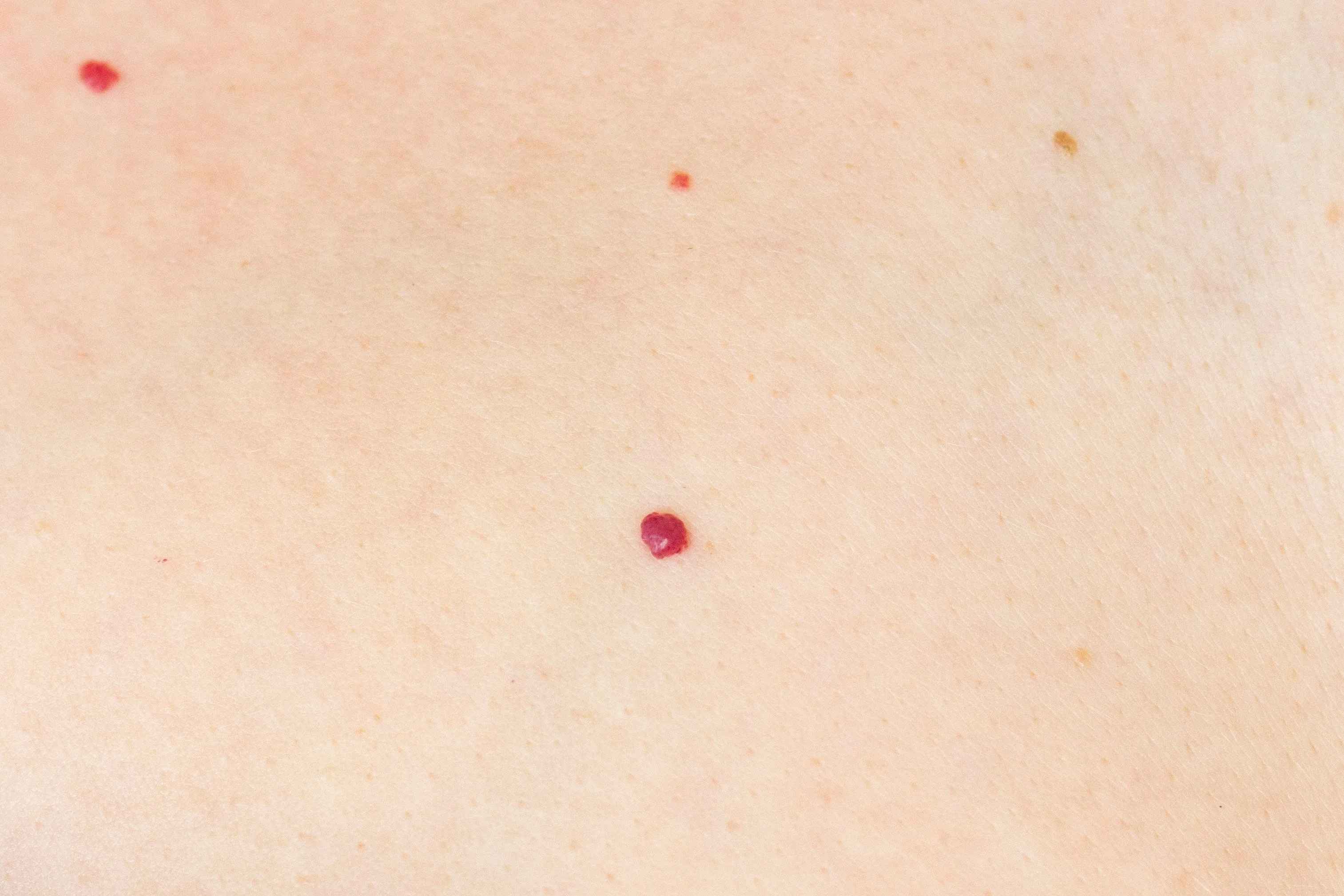
*Photo: Elena KHarchenko / Getty Images*
Cherry angiomas can occur on any skin tone, though Thornburg sees them more often in people with lighter skin. They’re common enough that about half the patients she saw one morning had them. People may first notice a few in their late 20s or early 30s, then accumulate more with age; some develop hundreds.
## Age is the clearest risk factor
The cause isn’t settled. Angiomas appear to run in families, which suggests genetics may contribute. Age has a clearer link: Thornburg says almost all adults over 75 have at least some, a pattern described in [research](https://www.ncbi.nlm.nih.gov/books/NBK563207/).
Sun exposure may play a part, but the evidence is murky. AbdelHameid says cherry angiomas aren’t a direct result of sun damage in the way sunspots or liver spots are, and people who avoid the sun can still develop them. Hormonal changes may also affect their number or size: some women notice new or larger angiomas during pregnancy, and similar changes can happen around menopause, though less often.
## Usually harmless, but watch for changes
Cherry angiomas aren’t cancerous, can’t become cancerous, and aren’t contagious. AbdelHameid calls them “cute little decorations” on the skin. That reassurance has a limit: a sudden eruption of more than 10 to 50 spots is unusual and has rarely been linked with [malignant melanoma](https://pubmed.ncbi.nlm.nih.gov/30543562/), so it merits a dermatologist’s attention.
Get a new or rapidly growing spot checked, especially if it bleeds or worries you. A dermatologist can confirm whether it’s an angioma and may also perform a full skin check. Thornburg says patients often come in for harmless growths such as angiomas or [seborrheic keratoses](https://www.prevention.com/health/a73983692/what-are-seborrheic-keratoses/), and an exam sometimes turns up a concerning spot they hadn’t noticed.
## Similar-looking spots can mean different things
Dermatologists can often recognize cherry angiomas at a glance, AbdelHameid says. Still, several other lesions may look similar:
- **Pyogenic granuloma:** A benign growth made of abnormal blood vessels, often seen in children or pregnant people. It can grow quickly and bleed heavily. Compared with a cherry angioma, it’s usually larger, grayer, and more prone to bleeding.
- **Venous lake:** A blue or purple [dilated blood vessel](https://www.sciencedirect.com/topics/medicine-and-dentistry/venous-lake) near the skin’s surface. It’s often larger than an angioma and tends to appear on sun-damaged areas such as the ears or lips. Thornburg describes the two as cousins; venous lakes are also benign.
- **Amelanotic melanoma:** A rare skin cancer that may appear [pink, red, purple, skin-colored, or colorless](https://www.skincancer.org/blog/amelanotic-melanoma-it-doesnt-look-like-other-melanomas), rather than as the dark spot many people associate with melanoma. If appearance alone doesn’t settle the diagnosis, a dermatologist may biopsy the spot.
If you have several angiomas, they generally look alike. One that grows much faster or bleeds much more than the others deserves a closer examination.
## Removal is optional
Because these growths are harmless, treatment usually isn’t needed. Removal may make sense if an angioma repeatedly catches on clothing—such as at a waistband or bra strap—or if a larger, raised one gets snagged and bleeds. Dermatologists can remove them with vascular lasers, electrocautery, cryotherapy, or shaving. Removal for irritation is typically covered by insurance; cosmetic removal may come with an out-of-pocket cost.
Don’t try to remove one at home. Angiomas contain blood vessels, so they may ooze more than expected, and home removal can lead to infection.
## Prevention is limited
There’s no reliable way to prevent cherry angiomas, since age is the strongest known risk factor. Sun protection may help if UV exposure contributes, though that connection remains uncertain. It’s still a sensible habit: protecting your skin from the sun can reduce the risk of other skin growths, including harmful ones.


Discussion
Sign in to join the discussion.