U.S. health spending is forecast to reach $9 trillion by 2034, with growth cooling after 2026 while spending continues to outpace GDP.
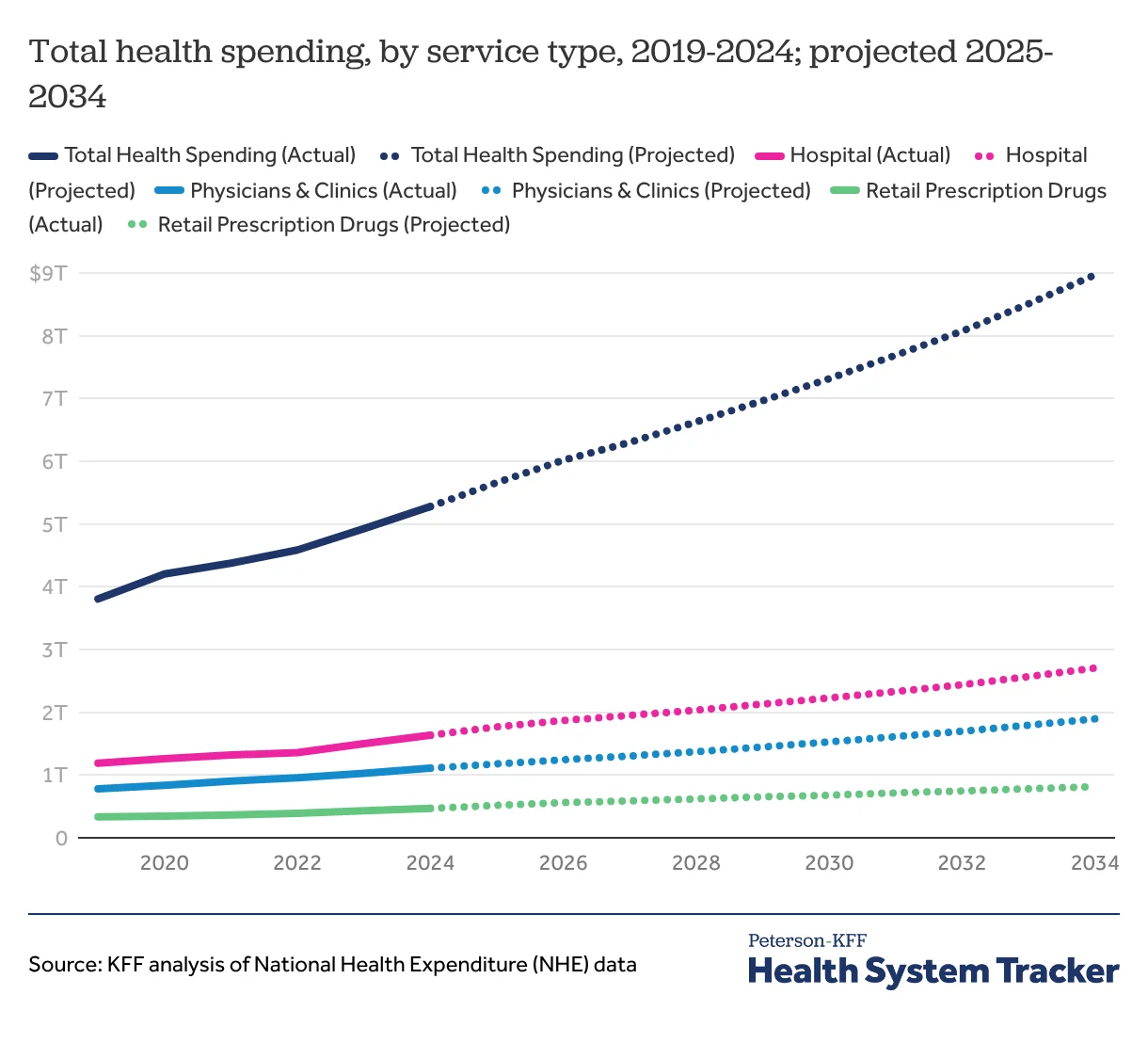
The headline forecast is hard to miss: U.S. health spending is projected to reach $9.0 trillion by 2034, or 20.6% of the economy. That scale matters. But the path there is uneven: spending growth is expected to cool after 2026, even as health costs continue to outpace GDP growth over much of the forecast period.
This chart collection draws on National Health Expenditure (NHE) projections and analysis from federal actuaries and economists. For historical comparisons, see this chart collection; the interactive health spending explorer lets you examine changes over time.
Spending reaches $9 trillion, led by hospitals
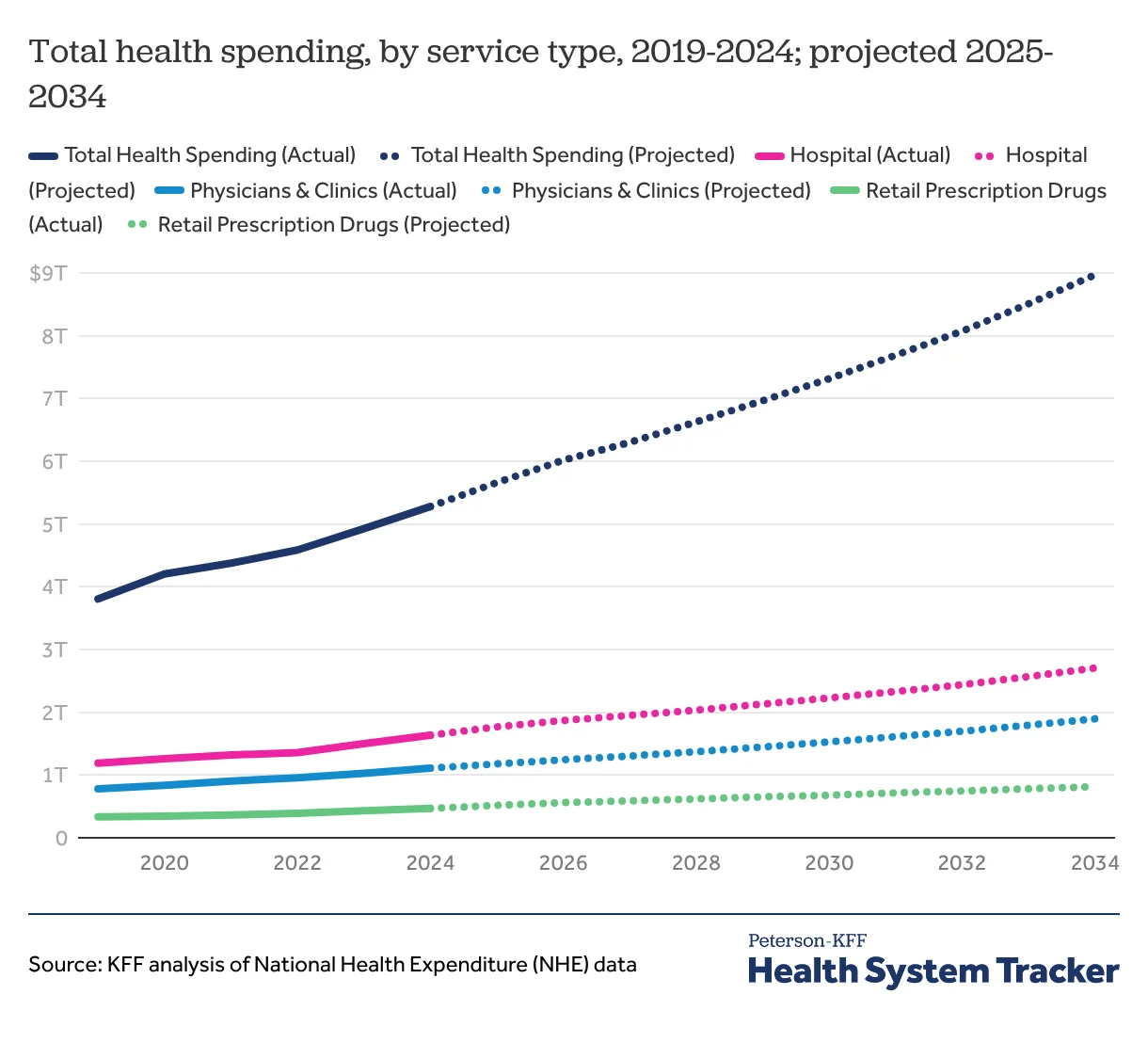
CMS expects health spending to total $6.0 trillion in 2026, equal to 18.7% of the economy. Hospitals account for the largest share, at $1.9 trillion. By 2034, hospital spending is projected to reach $2.7 trillion, or 30% of all health spending. Physician and clinic spending is forecast to reach $1.9 trillion (21%), while retail prescription drug spending is projected at $814 billion (9%).
Those retail drug figures exclude medicines administered by clinicians in hospitals, doctors’ offices, outpatient centers, long-term care facilities, and patients’ homes. Spending trends for those physician-administered drugs may differ from trends for retail prescriptions.
Growth cools after 2025
The projections point to a slowdown in 2026 across hospitals, physician services, and retail prescription drugs. That shift is worth watching: a slower growth rate still means spending is rising, and the longer-run totals remain substantial.
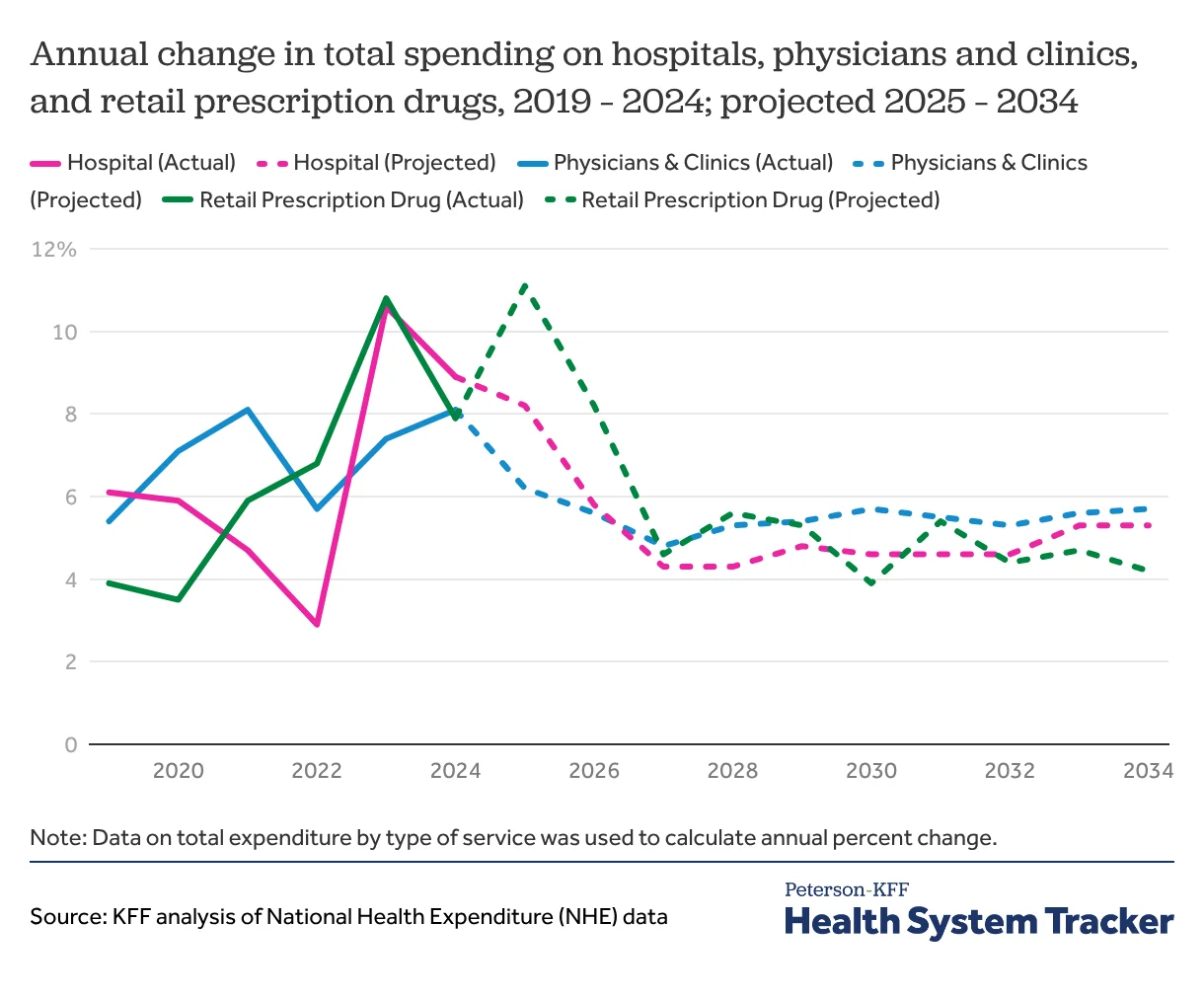
Hospital spending growth is projected to fall from an estimated 8.2% in 2025 to 5.8% in 2026. From 2027 through 2034, it is expected to average 4.7% a year. Retail prescription drug spending growth is forecast to ease from 11.1% in 2025 to 8.2% in 2026, then average 4.8% annually from 2027 to 2034.
Physician and clinic spending follows a similar near-term pattern, with growth projected to slow from 6.2% in 2025 to 5.6% in 2026. The forecast then puts average annual growth at 5.4% from 2027 through 2034.
Health spending keeps gaining ground on the economy
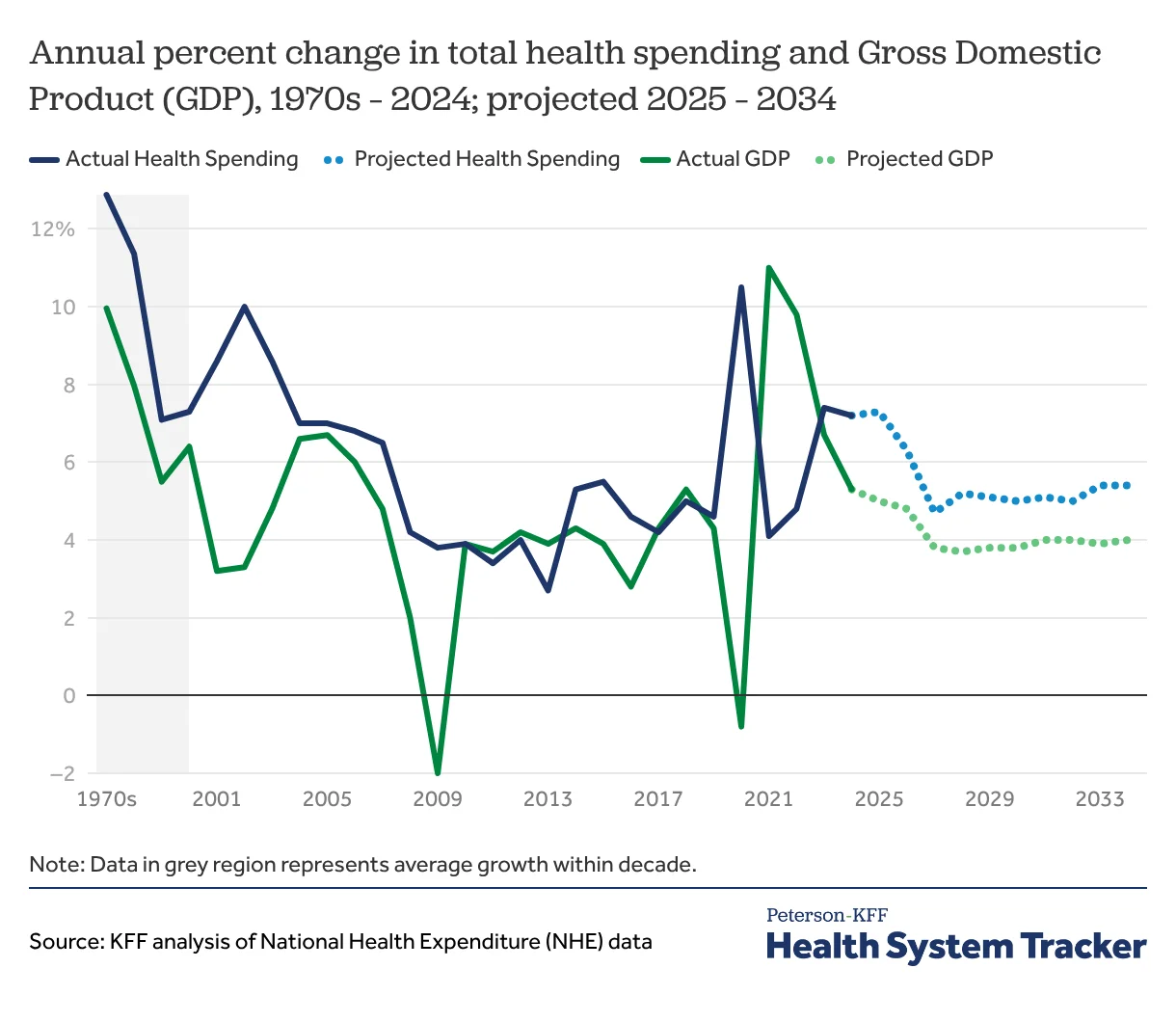
Health spending growth is estimated at 6.3% in 2026, then is expected to slow to 4.7% in 2027. From 2028 through 2034, the forecast averages 5.2% a year. Over that stretch, national health spending is projected to outpace GDP growth, partly because medical prices and health care use are expected to rise.
Several forces are expected to temper spending growth. CMS projects slower growth in health care use, including uptake of high-cost specialty drugs. It also expects the number of uninsured people to increase under Medicaid community engagement and eligibility requirements in the 2025 budget reconciliation law, as well as the expiration of enhanced ACA Marketplace premium tax credits in 2025.
Federal estimates differ on how many people will lose coverage. Still, the coverage changes are expected to slow spending growth in Medicaid and private insurance. Uninsured people are less likely to use health care than those with coverage, which also puts downward pressure on overall spending.
The Inflation Reduction Act (IRA) is another part of the forecast. Its Medicare prescription drug price negotiation and inflation rebate provisions are expected to slow Medicare drug spending growth over the longer term, though Medicare spending growth is projected to be higher in the near term.
Health care is projected to take more than one-fifth of GDP
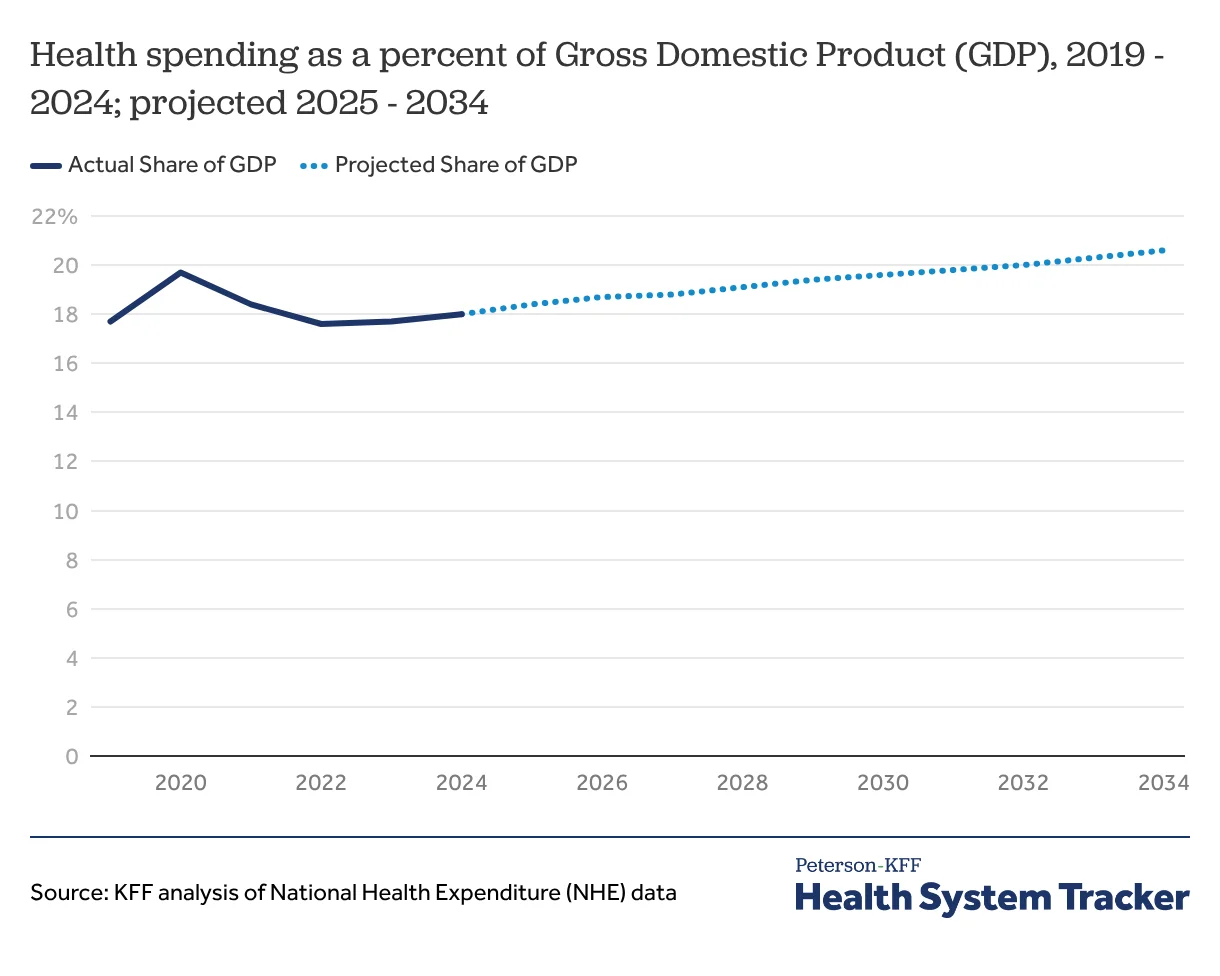
Health spending is estimated to have grown slightly faster than the economy in 2026, reaching 18.7% of GDP. The share is projected to keep rising, reaching 20.6% by 2034. The forecast’s slower annual growth rates therefore shouldn’t obscure the larger shift: health care is expected to claim a growing portion of the U.S. economy.
Retail drug spending growth moderates after a sharp near-term rise
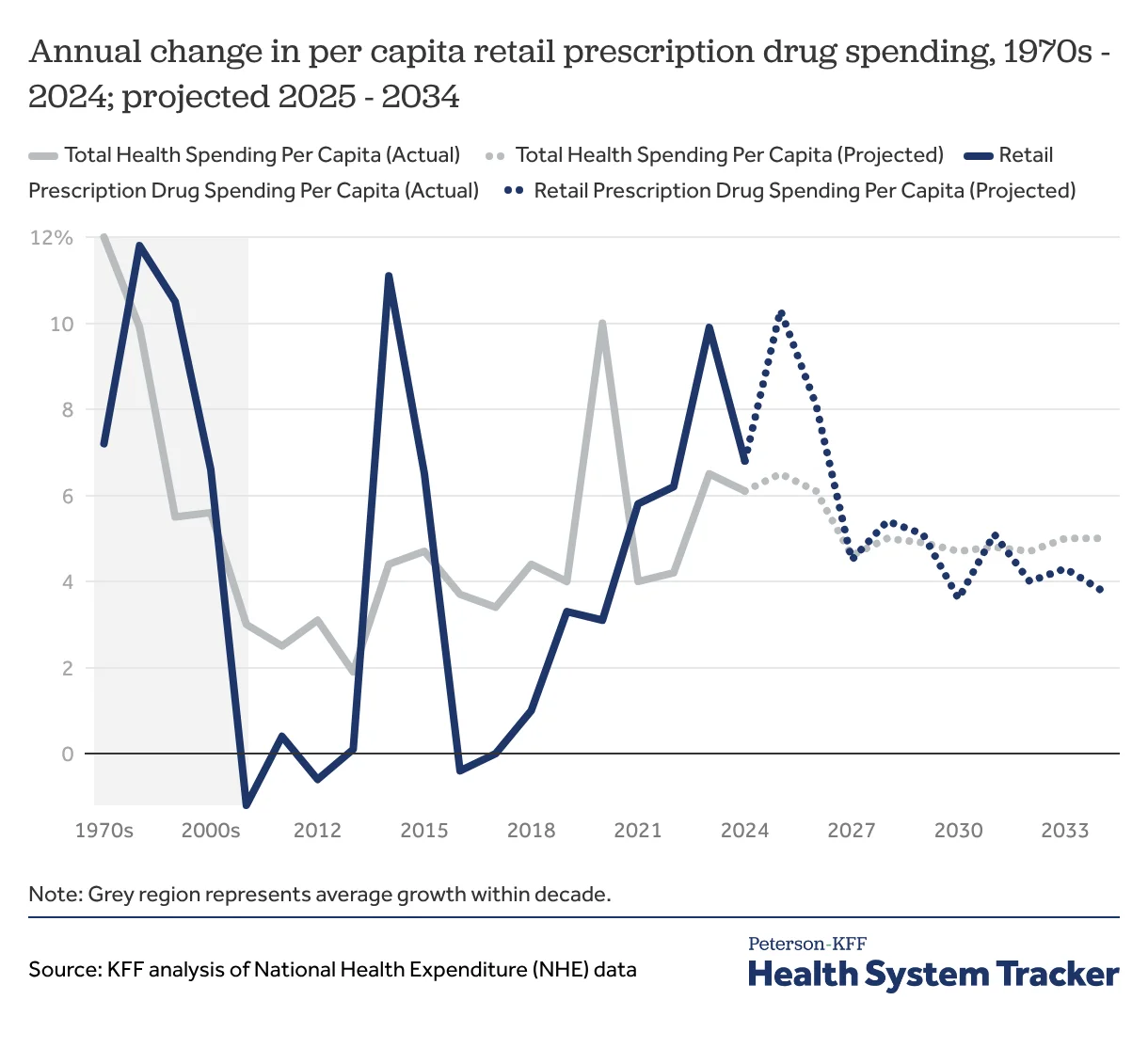
Per-person retail prescription drug spending growth is projected to average 4.5% a year from 2027 through 2034. That is well below the estimated 10.3% growth in 2025 and 8.1% in 2026. Greater use of high-cost retail drugs is one reason CMS expects the near-term increases to be elevated.
CMS projects slower per-person retail drug spending growth from 2029 through 2034, partly because use of GLP-1 drugs among Medicare enrollees is expected to moderate and the IRA’s Medicare drug provisions take fuller effect. Those provisions include negotiated prices and the Medicare inflation rebate. Drug forecasts carry real uncertainty, though: new medicines, particularly for diabetes, cancer, and autoimmune diseases, could change the spending picture.
Out-of-pocket spending growth is forecast to ease
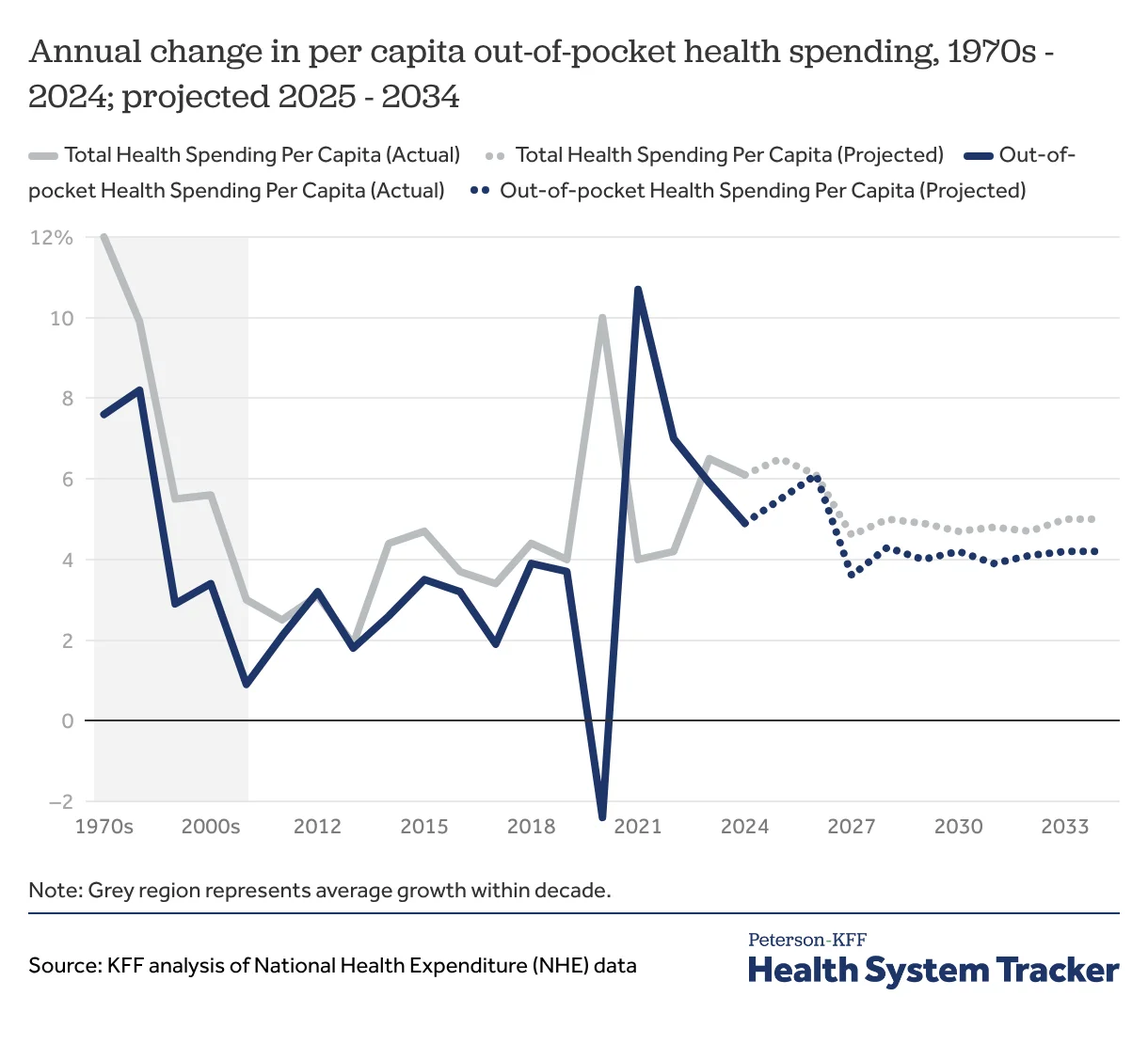
Per-person out-of-pocket spending growth is projected to climb from 4.9% in 2024 to 6.1% in 2026. Increased use of diabetes and weight-loss drugs contributed to that rise; some carry high cost-sharing, and some are paid for entirely by consumers without insurance.
After volatile growth in the early 2020s, CMS expects annual per-person out-of-pocket spending growth to average 4.1% from 2027 through 2034. Several IRA Medicare drug provisions are expected to restrain growth for Medicare enrollees: the 2024 elimination of the 5% coinsurance charge for catastrophic coverage, the Part D out-of-pocket cap—initially $2,000 in 2025—and negotiated drug prices. Details on the law’s Medicare prescription drug provisions explain how those changes work.
Private insurance growth spikes, while payer trends diverge
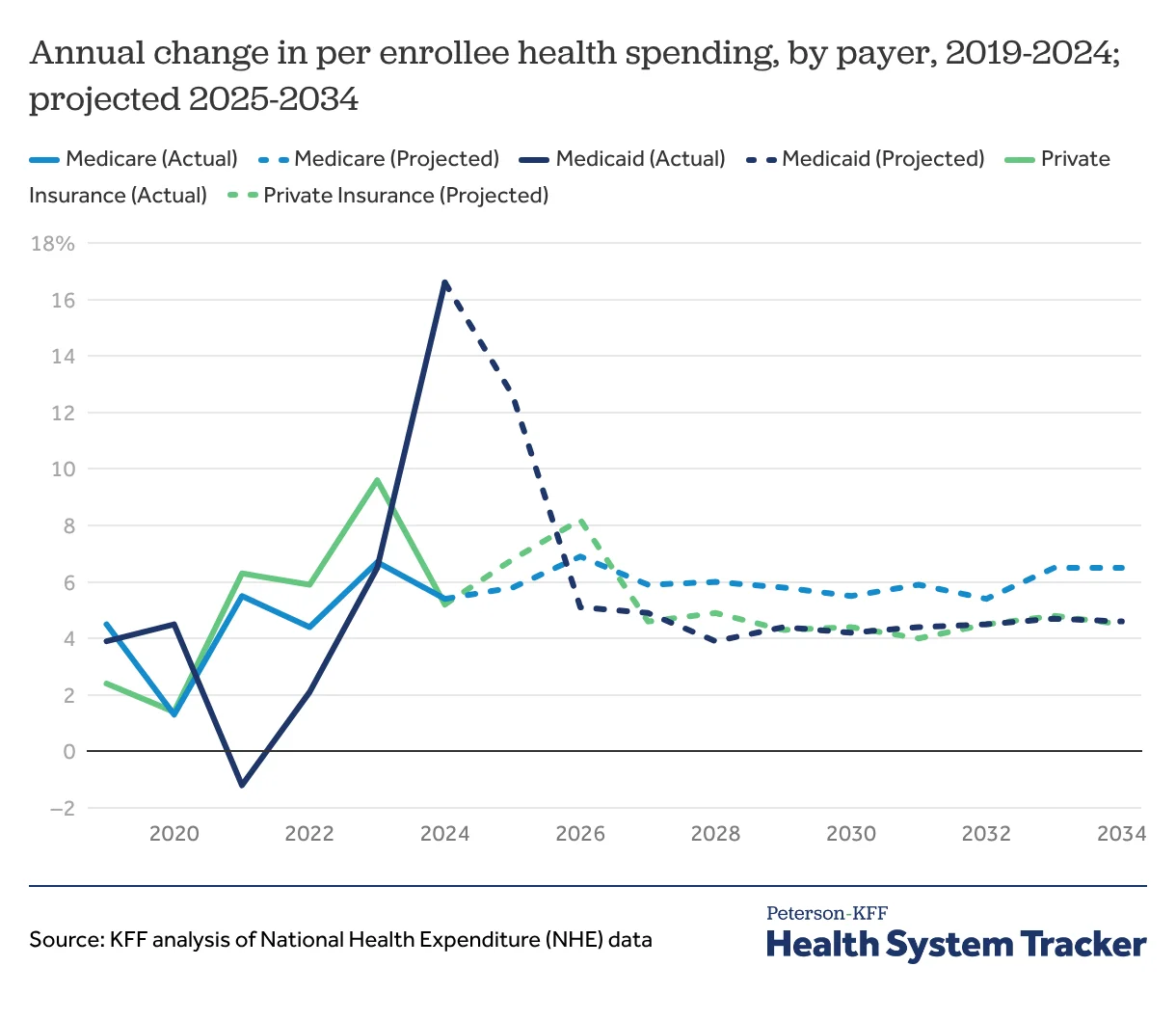
Private insurance spending per enrollee is projected to grow 8.2% in 2026, up from 5.2% in 2024. Higher spending on prescription drugs and hospitals is part of the explanation. So is the projected departure of younger, healthier ACA Marketplace enrollees after enhanced premium tax credits expire at the end of 2025. Growth is forecast to drop to 4.6% in 2027 and stay between 4.0% and 4.9% through 2034.
Medicare per-enrollee spending growth is expected to rise from 5.4% in 2024 to 6.9% in 2026, then slow to 5.9% in 2027. From 2027 through 2034, the forecast ranges from 5.4% to 6.5%. CMS expects some IRA drug provisions to curb long-term Medicare spending growth, while others may push it up. The Part D out-of-pocket cap, initially set at $2,000 for 2025, shifts some drug costs from enrollees to Medicare and Part D plans as prices and use grow. Drug price negotiation may initially raise Medicare spending growth by replacing rebates negotiated by plans with prices negotiated by Medicare at the point of sale; CMS expects it to slow Medicare drug spending growth from 2029 through 2034.
Medicaid’s per-enrollee numbers have also been shaped by policy. During the Medicaid unwinding, spending per enrollee rose 16.6% in 2024 as younger and healthier members were more likely to leave the program. CMS projects growth to drop from 12.6% in 2025 to 5.1% in 2026, as Medicaid spending growth slows and enrollment declines by less. From 2027 through 2034, per-enrollee growth is forecast to average 4.5% annually. State officials also project flatter enrollment after the unwinding, alongside spending and budget pressures.
CMS expects Medicaid provisions in the 2025 budget reconciliation law to limit spending and enrollment growth in coming years. These include caps on state directed payments, restrictions on provider taxes, and new community engagement and eligibility requirements.
Households will pay more across every major service category
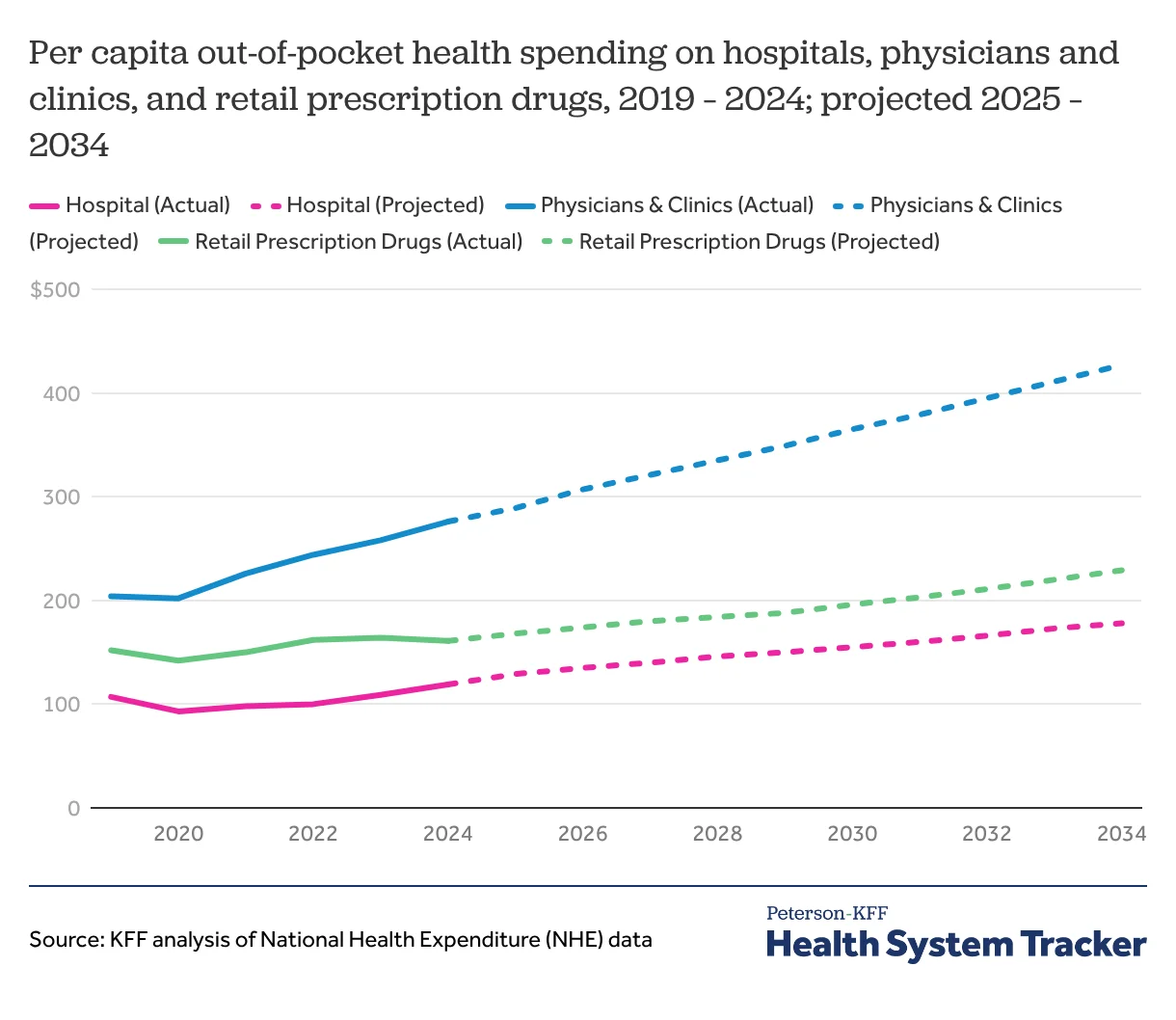
The rise in out-of-pocket costs is broad, though slower than the growth in total health spending. By 2034, projected per-person payments reach $178 for hospital care, $427 for physician and clinical services, and $229 for retail prescription drugs.
Those figures start from different baselines. Hospital out-of-pocket spending is projected to climb from $135 per person in 2026 to $178 in 2034, an increase of 31.9%, or an average 3.6% a year. Physician and clinical costs grow faster: from $307 to $427 per person, averaging 4.4% annually. Prescription drug spending rises from $174 to $229, an average annual increase of 3.5%.
Small forecast changes produce large differences
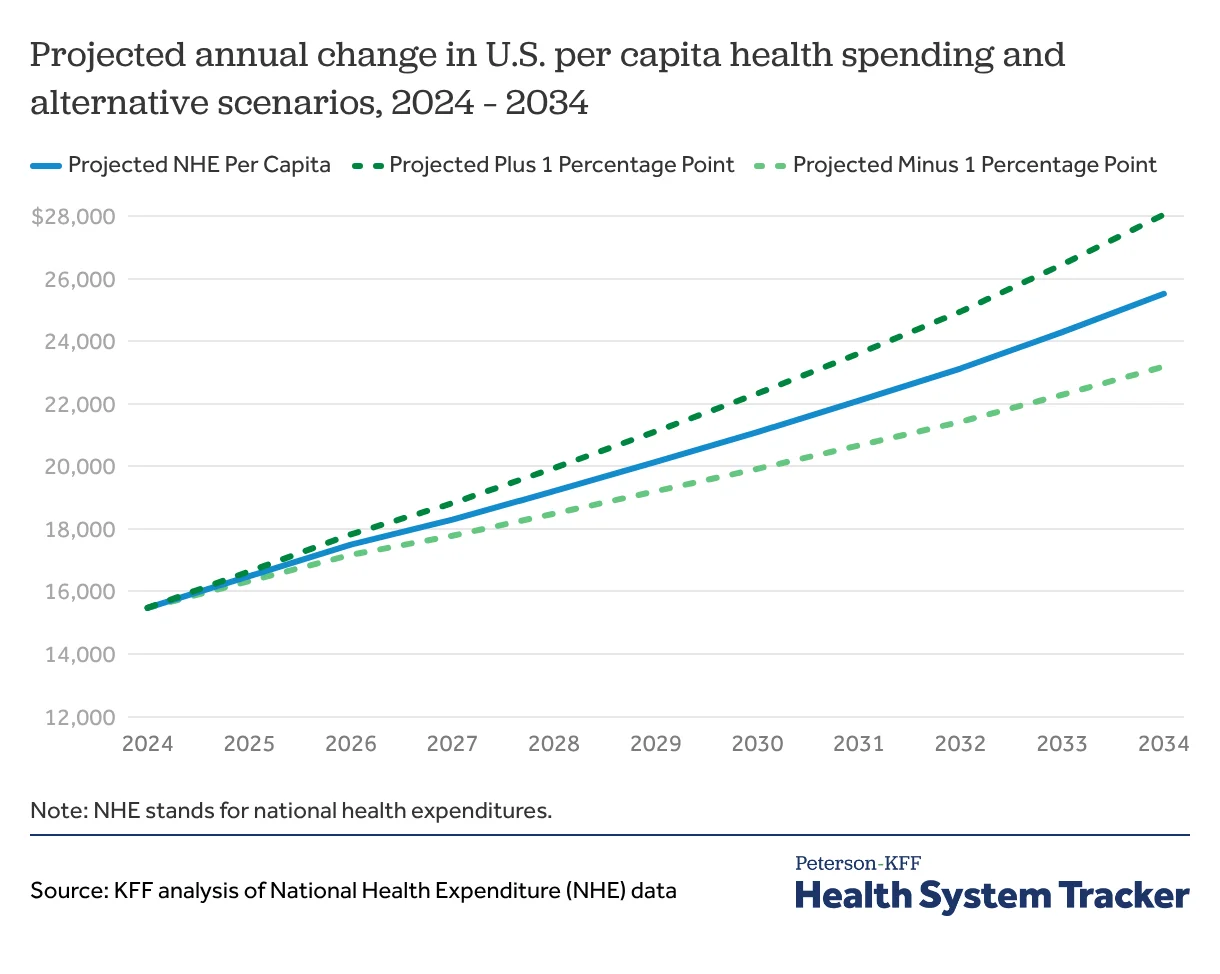
CMS expects per-capita health spending to rise from $16,486 in 2025 to $25,513 in 2034, an average annual growth rate of 5%. That’s a steep increase, but the forecast’s margin for error matters just as much: if annual growth runs one percentage point below projections, spending in 2034 would be more than $2,000 lower per person. One point above the forecast would put it at $28,046, roughly $2,500 higher.
Those aren’t remote details in a model. They show how quickly modest differences compound over a decade. CMS builds its estimates around demographic and utilization patterns, while changes in health care technology—including AI and expensive specialty drugs and therapies—could affect both costs and outcomes in ways the data doesn’t yet pin down. Economic conditions matter too, including shifts in health employment and bouts of inflation. And the continuing implementation of changes to Medicaid and ACA insurance markets adds another source of uncertainty. Forecasts depend on assumptions about what comes next; even small differences in growth rates can create large gaps in the final bill.
Today’s projections are lower than earlier forecasts
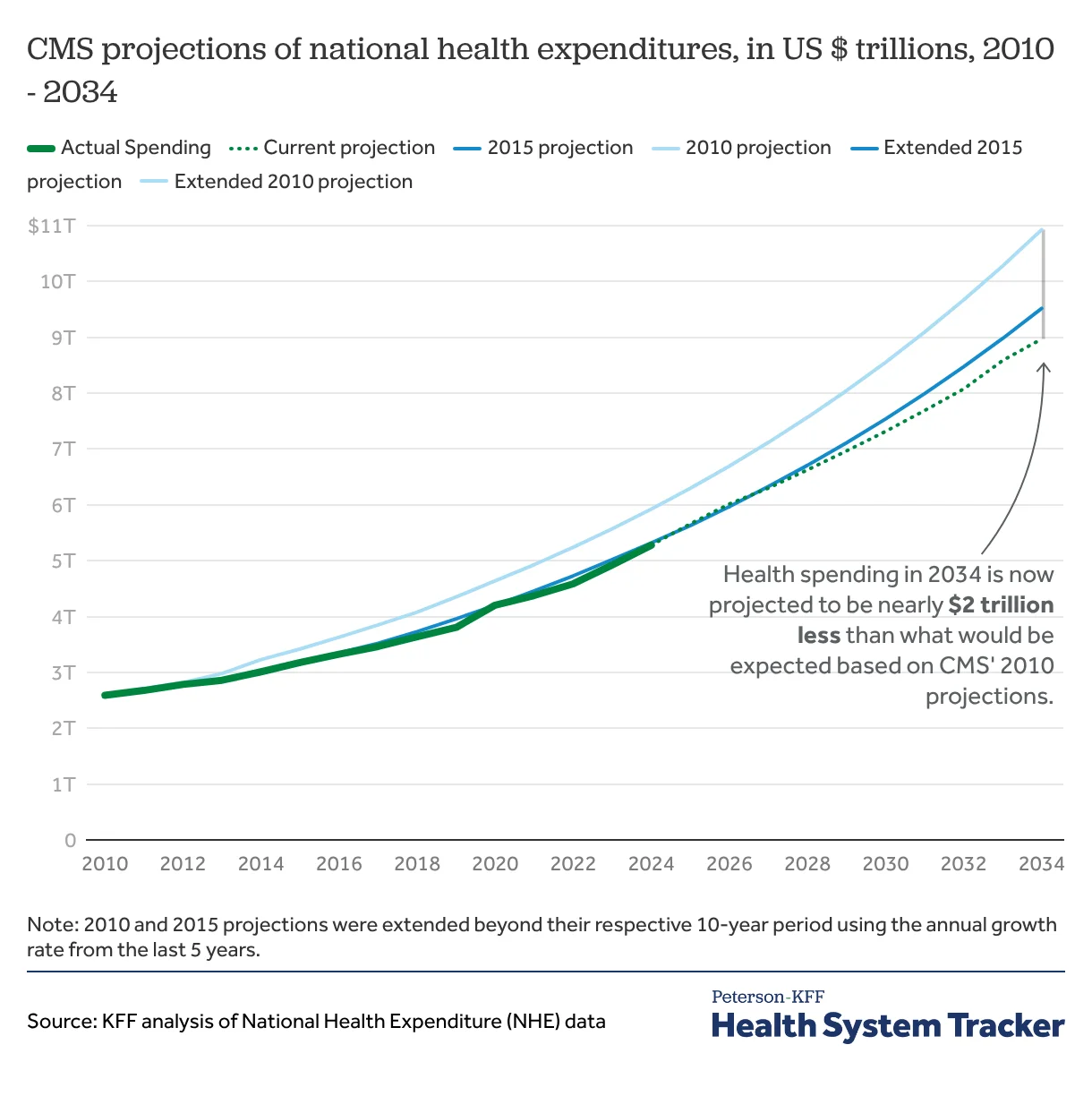
The longer view changes the story: health spending is growing more slowly than CMS once expected. Its 2034 projection is nearly $2 trillion below what the agency’s 2010 projections would imply, and nearly $550 billion below the figure implied by its 2015 projections. Part of that gap reflects slower spending growth toward the end of the 2010s.
This doesn’t make the current forecast certain. It does show why older projections shouldn’t be treated as a straight-line guide to future costs—and why the assumptions behind any long-range estimate deserve close attention.
The post How much is health spending expected to grow? appeared first on Peterson-KFF Health System Tracker.



Discussion
Sign in to join the discussion.