U.S. Life Expectancy Rises to 79 Years, Yet Still Trails Behind Wealthy Peers
Published Mar 31, 2026Reads 572By Shameek Rakshit
Despite reaching a record 79 years, U.S. life expectancy lags behind other wealthy nations, raising questions about healthcare effectiveness and disparities.
The U.S. Remains Behind in Life Expectancy Despite Recent Gains
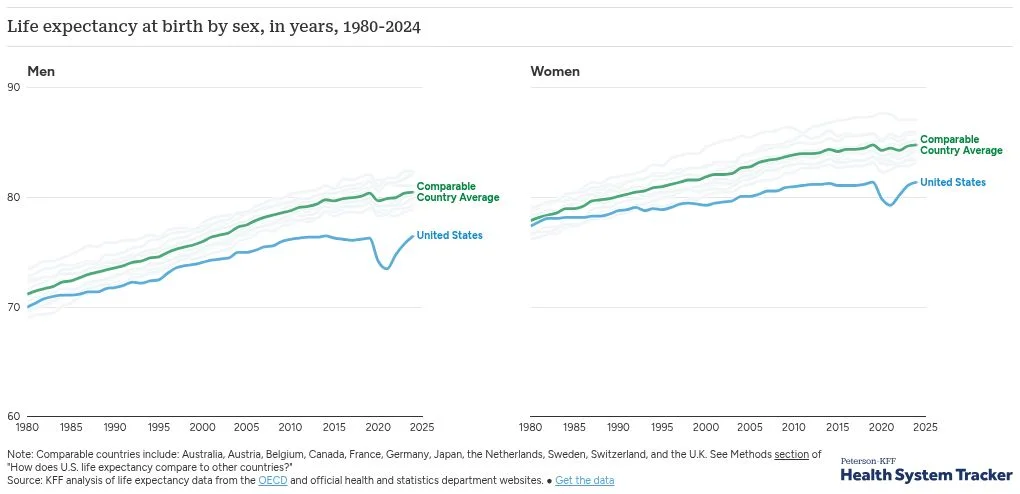
Life expectancy in the United States has reached a record high, clocking in at 79 years in 2024. This modest bump from 78.4 years in 2023 certainly paints a picture of gradual progress; however, the gap compared to other wealthy nations is striking. Countries like Australia, Canada, and Germany boast an average lifespan of 82.7 years. The U.S. trails by a notable 3.7 years, a gap that highlights alarming disparities in health outcomes. Despite this incremental improvement, it underscores a long-standing issue: the U.S. struggles to keep pace with nations that share similar economic profiles yet achieve consistently better health results.
Here’s the irony: the U.S. spends close to twice as much on healthcare per capita compared to these countries. This paradox raises critical questions about the efficiency of the American healthcare system. You'd think that with heavy financial investments, the outcomes would be markedly better. Spending did see a dramatic increase—around $5,000 more than Switzerland, the next highest spender—yet this financial commitment hasn't translated into corresponding health benefits.
This situation reflects systemic inefficiencies within the healthcare system. The high cost of medical care can often be attributed to administrative expenses, high salaries for healthcare providers, and the prices of prescription drugs. While some advocates argue that these costs reflect the quality and availability of top-tier medical services, the evidence suggests that overall population health doesn't correspond similarly. Essentially, for the vast sums spent, the returns in terms of increased longevity and quality of life simply aren't there.
Minor Improvements Mask Persistent Disparities
The recent uptick in life expectancy can be attributed in part to reduced mortality rates from unintentional injuries, including drug overdoses, as well as decreases in deaths from chronic illnesses and COVID-19. However, the implications of these numbers are more complex than they seem. While the U.S. life expectancy saw a decent rise of 0.6 years, peer countries experienced minimal change, averaging just a 0.1-year increase. This indicates that while America is making slight progress, it's still not enough to meaningfully narrow the gap with its rivals.
Moreover, the difference between U.S. life expectancy and that of comparable nations has historically widened over the decades. Data across various studies show that between 1980 and 2010, both the U.S. and these other countries witnessed increasing life spans. But then things began to diverge. The U.S. saw a stagnation in growth during the 2010s—an increase of just 0.1 years, sharply contrasting with an average 1.2-year increase in peer nations. This stagnation is closely related to rising mortality rates from suicide and drug overdoses, demonstrating the complexity of U.S. health challenges.
What this means for you if you're in public health or policymaking is clear: focusing solely on immediate health outcomes isn’t enough. Long-term strategies addressing mental health, substance abuse, and socioeconomic inequities are desperately needed. The health crisis running parallel to opioid addiction is one of America’s most pressing issues, and fixing it requires a comprehensive approach that engages various sectors, including education and community services.
The Gender Gap: A Notable Discrepancy
Another significant story within these statistics is the disparity in life expectancy between men and women. As of 2024, women in the U.S. are expected to live, on average, 4.9 years longer than men. While this reflects a common trend seen in other countries, the gap in the U.S. is wider than the 4.2-year difference noted among peer nations. Interestingly, this marks a slight decrease from the prior year, when the gap was 5.3 years, indicating a slow improvement in male longevity.
This gender gap serves not just as a statistic but also as a lens into broader societal issues. For instance, men are typically more likely to engage in riskier behaviors, including substance abuse, which can contribute to higher mortality rates. Yet, this issue isn’t one-dimensional. Women may experience different health risks or may be more proactive in seeking healthcare, skewing longevity data further. Both genders in America still live shorter lives than their counterparts in similarly affluent nations. This becomes especially problematic when you consider the existing healthcare disparities that Americans face based on socioeconomic status, access to care, and racial backgrounds.
It's a complicated picture, and while progress is evident, the U.S. healthcare system remains under scrutiny for failing to deliver the results its spending would suggest. If you're involved in public health or related fields, these statistics are more than just numbers—they reflect systemic issues that need addressing.
Future Implications and the Path Ahead
Looking ahead, the implications of these findings are critical. If the U.S. hopes to close the life expectancy gap, fundamental changes must occur in healthcare access, preventive care, and social determinants of health. The rigid stratification based on income and race in healthcare accessibility has real consequences, leading to poorer health outcomes for marginalized groups.
Moreover, addressing mental health and substance abuse issues should be at the forefront of public health initiatives. There's a pressing need for greater awareness and funding surrounding these challenges, which have spiraled into a public health crisis that impacts communities across the nation. The opioid epidemic, for one, began as a crisis of choice and mismanaged healthcare, but it has transformed into an urgent call for systemic change.
You might think improvements in life expectancy are merely a statistic. But they represent something far more complex—an intricate web of societal health. And this is the part most people overlook: without addressing these underlying issues, mere increases in spending or improvements in healthcare technology won't yield tangible gains in public health.
As stakeholders across various sectors come together to strategize, it's essential to keep focused on both immediate outcomes and long-term solutions. The goal isn’t just to increase numbers on a chart, but to enhance the quality of life for all citizens. The path ahead is difficult, but it’s where the conversation needs to go if the U.S. is to survive in this global health race.

Discussion
Sign in to join the discussion.